


Scaling Up A Customer Success Team
Your product idea has become a success! Your NRR is growing steadily every quarter and you have taken the first steps to scale your Customer Success team (CST). But what can you do to ensure that your team has been designed to function efficiently? That is what I am going to cover in this article. In my previous work I presented an idea on how to scale of a Product Led Growth-first CST. Now I want to explore scaling and building your CST in harmony with your Sales Team that ensures a consistent experience for your customers as they began their journey from your Sales team to your CST. I have combined my experience in scaling a CST with the advice of other successful Customer Success Heads to put together this handy guide.
Communication:
Its crucial that the entire CST know the existing sales pitch for your product, and/or a consistent understanding of what the product does. It can be daunting for customers to hear different variations of what your product does and how it can help them maximise their KPIs using your product. You do not want to land into a situation where customers are presented a different version of your product during the onboarding process.
This can be mitigated by good training and leadership. I would recommend that the heads of the Sales Team, CS, and Marketing frequently get together to unify and create a singular communication message. This ensures consistency of product image from marketing, sales and eventually Customer Success following team presentations and/or trainings.
Building a Customer Journey Combing CS and Sales
If you wish to combine your CS and Sales Team this is an example of how you can structure the Customer Journey:
- Lead Generation
- Sales team
- Onboarding Team
- Farming Team
- Retention Team*
- Customer Experience
Let us shortly delve into each one:
Lead Generation
This is your client acquisition channel. Depending on the type of product you are selling there are several strategies that will help you maximise client acquisition. If you are struggling on acquiring customers the book “Traction” written by Gabriel Weinberg and Justin Mares is a great starting point. But say you have nailed this step and you have identified a growth channel that consistently grows your business and is ROI positive. The next step for your customers is to either get started with your product, or they will request a demo, or be contacted by a Sales representative.
Sales Team
In this makeshift start up example, our companies Sales Team is responsible for working with the acquired leads, and with the information that have either been provided or have collected will begin putting together a coherent onboarding plan for the client. The type of information that they will want to gather includes:
- What problem do they wish to solve with your software
- What are their expectations for your software
- Outline KPIs – what metrics do they wish to uplift
- Who will be primarily using the product
- Timelines – how quickly do they want to be up and running and generating positive ROI with your product
This information needs to be jotted down and ideally uploaded into a CRM, so information remains transparent and accessible by both the Sales team and the CST. It is possible to create checklists on many CRMs to ensure that the Sales Team have collected all the necessary information for an impactful onboarding for the client that will later be handled by the CST.
Onboarding Team
In this start up we have an onboarding team that specialises in getting clients up and running with the product. This is not as uncommon as you may think. Companies such as Deel hire specialists in onboarding that focus on training new clients in using your product, host welcome calls and prepare dedicated 30-day onboarding journeys. This process can be more hands-on (it does not have to be!) but is usually time dependent.
In this stage you can also offer your clients an office visit, where a CSM can sit with the client and explain the product in a more personal manner. This is an excellent method to build personable client-relationships and give your CSM an opportunity to organically learn how a new customer approaches your product. Potentially revealing loopholes in product design or identify areas of confusion that the product team had originally not identified.
Farming Team

This term might be new for some. But a farming team is responsible for the next stage of the customer journey. After onboarding your client should ideally know how to use the product, have a few use-cases up and running and are getting some initial results or output from your product. The farming team directs your flock of customers towards the pathway of success. Their focus is to prevent churn, focus on ROI generation for your customers, guiding product adoption, and cross-selling/upselling. This is where your Customer Success Managers (CSM’s) will spend their majority of their work day.
Alongside those responsibilities, its highly encouraged that your CST have access to product data and metrics to determine the health of your clients and take actions should any visible red flags appear (ex. Low product usage, low log-in rates, low use-case activation numbers).
Retention Team*
I am adding this section in but the effectiveness of this strategy is highly debatable and I will explain later why.
The Retention Team is simple in nature, but challenging in execution. The goal here is churn rescue and mitigation. This team will often have prepared aggressive churn strategies to mitigate churn. This can involve giving clients more hands-on support, personally creating use-cases for the client, giving premium or additional features on a limited time offer to improve results.
The reason why this approach is debatable is because if a customer has already gotten to this stage of the journey, the decision has already been made and it can be very challenging to reverse. Especially if your client has several stakeholders. Your client may have already selected a competitor software provider, or their financial situation is as such that they cannot justify the expense on your software anymore. Because of this, some Heads of CS argue that it is better to focus more resources in the previous stage and focus off eliminating red flags during their contract with your software.
Customer Experience

More and more so we have seen the CST being split into two sections. One is the Customer Success team that generally handles the responsibilities that I have listed above, and the other half is the Customer Experience team. This team is responsible for the ‘everyday’ work in a software business. Responding to tickets, product support, and responding on forums. This team has arguably become more important in the space of SaaS since customers are becoming less interested in building strategy together and will only want to contact you when a problem emerges.
Product support channels can always be developed. Your team can start by producing writing content, and eventually video content in the form of courses to further improve client engagement with your product.
How to Manage the Team Split
I am the Head of a Customer Success team, and currently we have 12 employees that are working in the CST. An effective strategy is to split the team on a basis of one Customer Success Manager for two Customer Care agents. The roles are different and hence their KPI’s will reflect that. In essence, members of the Customer Success team will be responsible for the hands-on work (Onboarding, Farming) and Customer Experience will be responsible for Customer Care. Responsibilities and KPI’s can be broken down in this table below:
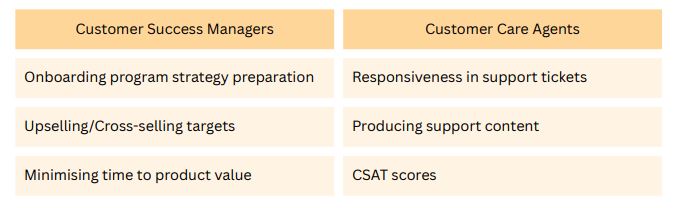
This split can also naturally create a hierarchy for your CST. Customer Care Agents will generally be younger and starting their career at your firm. They will have the opportunity to learn the ins and outs of your product and business, before being promoted to a Customer Success Manager role where the level of responsibility will be elevated. The one-two split can also end up being financially positive for your business as you will require less experience and expensive staff members to run your CST operation.
It is important to mention that the extent of this split should only be considered once you have an excellent understanding of your user base. If you realise that in your market more customers demand hands-on approach as opposed to support, you may want to reverse the split and prioritise more CSMs instead.