


Structuring a Modern PLG Customer Success Team
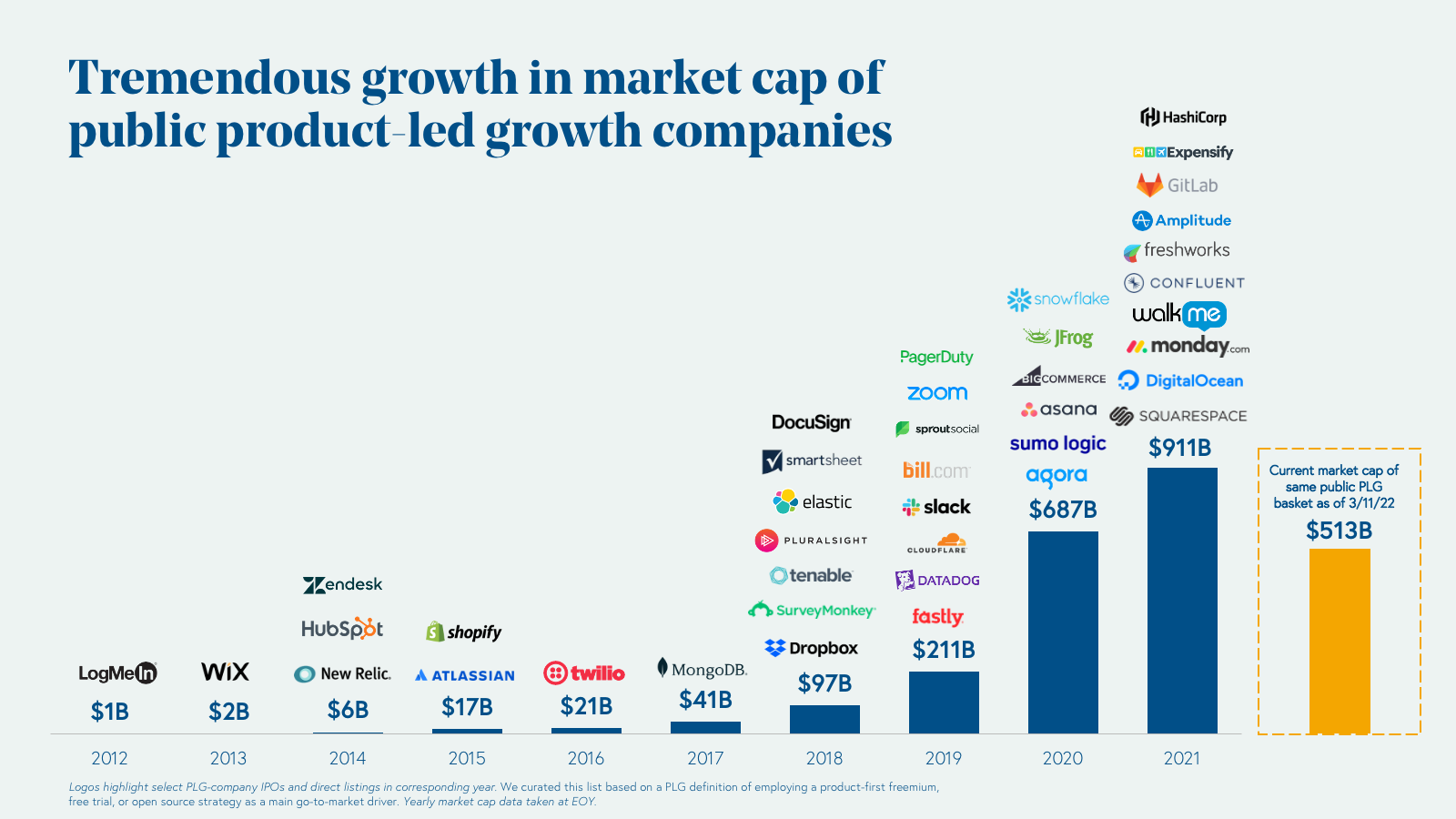
As of 2020 there is a high likelihood that your SaaS IT business has begun or fully embraced a product led growth (PLG) model. This model has surged in popularity by what I believe are two key factors. One – the pandemic has forced us to rethink how we interact with clients, and two – cost cutting measures. The appeal of a PLG model is that your customers are provided with the tools and resources that are necessary to use your product without any assistance from your support or customer success team. Today we want to encourage our users to ask their questions on a forum, or to simply search for the answer themselves via product provided support materials.
The benefits are clear. Customers can create and produce things faster since they do not need to wait for support, and SaaS companies do not need to expand their support or Customer Success teams. But to get to this point how can your possible structure your Customer Success Team (CST) to embrace a PLG model? How hard is it to create a fully functional CST, and how many people do you need to employ? The truth is, it does not take a lot to create a well-functioning automated CST and I am going to show you a model that works!
I do want to point out that today it is not uncommon to see more mature companies split responsibilities of the CST into two. A support team that directly handles customers tickets and inquiries (often younger, fresh graduates), and a dedicated Success Manager or Account Management who handles more high touch clients such as enterprise level customers. Their responsibilities for upselling, product pitching and product strategy remains unchanged even in this model.
To get started let us look at the model and I will explain why I have broken it down into key quadrants:
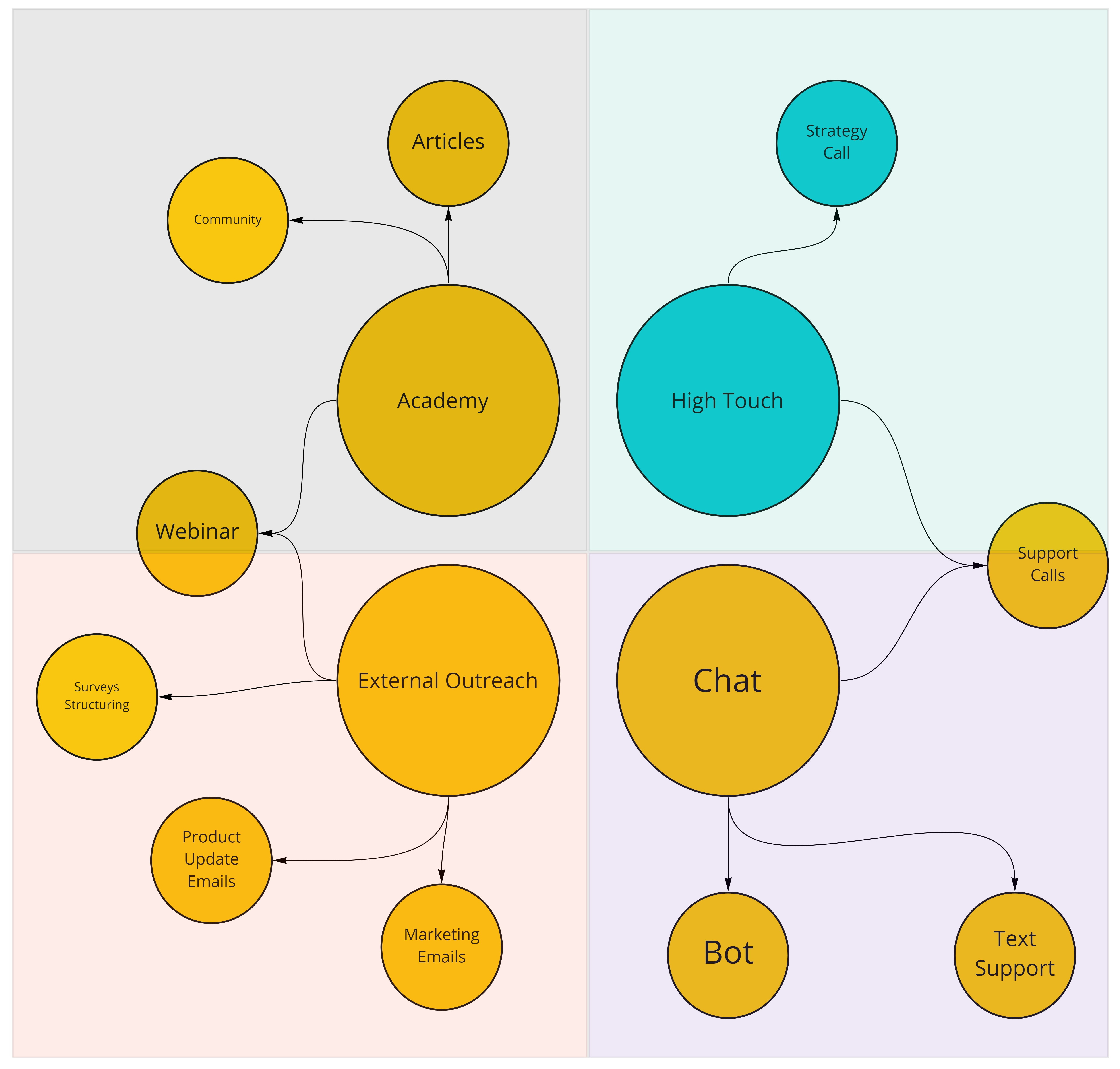
I have recognised that a modern CST model can be broken down into 4 main components. It needs to have an academy (Knowledge base, Wiki, Learning Centre – you can choose any adjective you want). A team dedicated to external communication to clients or prospects via marketing communication. A support chat team/structure that can handle complex product inquiries. Lastly, and potentially optional – experienced Account Managers who can manage Enterprise level clients. I have coloured the first 3 components as yellow as I consider them mandatory for a PLG model to succeed, and for an additional benefit. Depending on how complex your product is, or the size of your user-base. The 3 yellow components can honestly be handled by a single person. The blue circle (high-touch) is usually a position that requires significantly more man-hours to be able to effectively strategies and communicate with individual clients.
Let us quickly dive into each one:
Academy

This is straightforward. Any PLG company needs to make articles available to their customers so they can use the product. This is a time-consuming task, but it only needs to be done ONCE! How you organise the articles is entirely optional and the number of software options are endless. Often software that specialise in support tickets (Freshdesk, Intercomm, etc.) will also include support material capabilities.
The key attribute to what makes a good Academy is great searchability. It is vital that a user that easily find and answer to their problem via key word search. There is nothing worse then being forced to sift through hundreds of articles to find your answer.
Additionally, an Academy can be developed in stages depending on your resources. You can start with articles, then focus on video content once you have the available man-power to produce high quality educational videos.
Within this circle you can also create a community. This can become a central hub for your users to share feedback, create forums describing their problems or learn about all the latest product updates. This as well does not take long to set up, and once set up you only need an individual to moderate and manage the forum.
External Outreach
Since you are not interacting with your paying customers on a daily, weekly, or even monthly basis. There needs to be mechanism in place to effectively communicate or convey new product information to your users. This is important because announcing new features, promotions, and updates, creates excitement for your customers!
Therefore, you need to send out marketing emails and product update emails. I made these two sperate circles for a reason. Marketing emails can be sent in the form of a newsletter to your current, former, or perspective users. If your company also creates other marketing materials such as testimonials or social media content; you may want to include those links in your newsletter. The readers should often be decision makers or stakeholders who approved the purchase of your software (can even include individual users!) and they are more likely to positively engage to this type of content versus straight product updates. Meanwhile, product updates interest the actual user who is using it every day. They need to know what is new, what is changing and this in turn excites the daily user.
Lastly, we have surveys. There are numerous survey styles you can send out, and there is an ongoing debate about the value of user surveys. I am not going to dive into this debate in this article. If you wish to send out surveys to your users its best to approach it in a strategic manner. This means sending out the correct style of survey to a specific user demographic. Generally, you may want to consider sending out:
- NPS survey to your decision maker (enterprise level only) on a quarterly basis
- CSAT survey to your daily users (all users) on a quarterly basis
- Feedback survey to your churned users.
The best part about surveys is that this can be an entirely automated process. Set up the survey once, set a send date of every quarter and you are good!
Webinars
Webinars are unique that they fit into both these categories as they can both educate and inform users. Webinars often require more work and viewership is not always guaranteed. But its important that each webinar has a specific focus. It can be used as a sales tool to provide leads or prospects additional information about your product and answer their questions. You can host quarterly webinars to educate users how to use unique features of the product (in the format of tutorial’s). Or use webinars as a general marketing education platform and invite other thought leaders to discuss their experience and advice. Regardless of the webinar approach style you wish to employ. You do need to think about what value it will have for the customer. Will we answer a question for them? Will we listen to user feedback? Will we offer incentives for prospects as a token of gratitude for joining the webinar?
Chat

A CST can offer either (context of small start-ups) two types of chat styles. Live or support. I strongly advise against a live support if you have a small team or a complex product. Its far better to request customers to send in support tickets describing their problems and waiting a few hours for a response. Yes, this does ruin the users work flow. But in order to maximise the CST members time-management this is the best method. During the ticket request form, please request that your users describe their problem in as much detail as possible. Also make sure that the ticket request form enables for sending media (videos or photos) of the problem. This makes troubleshooting much easier.
If you wish to use live chat to answer simple questions, perhaps consider the use of an automated live bot where you can tailor design your workflows to manage FAQs.
High Touch
This method of communication and support should be reserved for enterprise level clients. There are a few key reasons why you may want to consider offering higher level of support to these types of clients – particularly if you are a small start-up operating in a competitive software space:
- Their fees will economically justify the hiring of experienced Account Managers
- Increases the likelihood that the customer will see success using the product as they will be guided properly
- Retaining enterprise level clients is very good for your company portfolio and marketing strategy
- Enterprise level clients often have multi-domains, officers that can also use your product via expansion strategies
- Exceptional support is a reason why companies purchase software – make this a selling point of your company!
This area of your business can certainly grow into its own department therefore I am not going to go too deep into structuring a High-Touch CST model into this article. To keep it brief I would recommend that your Account/Customer Success Managers at the very least provide:
- Detailed onboarding that clearly illustrates how your product can hit their KPIs and what needs to be done to achieve said goal
- Training/workshops that help the account use your product
- Monthly and quarterly meetings/calls to make sure you are both on target regarding usage of the product (hitting all major KPI goals)
Support Calls
This category really does fit into both the High-Touch and Support model and thus deserves its own paragraph. I do believe that if you are a smaller company, you should offer support calls to your customers. This should perhaps not be an encouraged option, yet still made available.
To try to discourage abuse of support calls by certain customers, you can set up hurdles for your customers before booking a call. An example of a journey can look like this:
Academy Search --> Community --> Chat Support --> Contact a Member of Team
Like a support ticket, it should be required that users provide as much information to the support agent prior to the call. As this helps the support member prepare for the call. Strategically you can also utilise these calls as a mini feedback session (after the problem has been solved) to extract some additional value from these support calls. If you find that your support team is spending too much time on support calls answering redundant questions, I would eliminate this process or simply add more hurdles to booking a call.
You can place restrictions for who can receive support calls. This can be done by restricting calls to only paying customers and enterprise level accounts. Support calls should not take more than 30 minutes.
Final Thoughts
I created this structure under the pretence of a small CST because often more resources are set aside for product development over the CST. Therefore, this proposed model has been created in such a way that it can be set up by few, and made functional by even fewer. Much of these processes are set up once, and can be left alone for a prolonged period. Even external outreach strategies do not require that much work. Once a marketing or product update email template has been established, creating content is not that much of a time-consuming task.
The processes on the right-hand side are time consuming. Therefore, its important to prioritise establishing a solid network of support materials and making it readily available to customers. This will immediately reduce the strain of the amount of support tickets and calls you are receiving. If this is not happening, rethink your academy strategy. Maybe the articles are not written correctly? Are your users aware of your academy? This can be researched by user feedback surveys/calls or via stats which are often provided by the software host of your support articles. The goal here is to eliminate redundant tickets and ensure that your support team is only helping customers achieve the most complex of challenges. Because once a user has gotten to this stage, it means that they are already well inversed in your product and are less likely to churn.
The four quadrants are not the only channels that can be utilised to increase your customer outreach. You can also utilise other channels such as SEO optimisation, content marketing offline/online ads, and so forth. Yet I would strongly argue that other channels will fall out of the wider responsibilities of the CST and into the Marketing team territory.
Lastly, whilst the PLG model sees no sign of slowing down. I see no reason why you should not merge aspects of high-touch into the PLG model. For small companies that are struggling to penetrate their market, high-touch can be a great way to stand out from the competition as you are able to offer more direct and better support over your competitors.